Four weeks into retinol, your skin looks worse than when you started. The question everyone asks is whether to push through or stop.
It is a good question, because the answer genuinely differs. One of these resolves if you continue. The other gets worse.
What purging actually is
Retinol speeds up cell turnover. Congestion that was going to surface over the next six weeks surfaces over the next two instead. Nothing new is being created — the timeline is being compressed.
That gives purging a signature you can check against.
The four tells
Location. Purging turns up where you normally get congestion. A reaction turns up anywhere, including places that have never given you trouble — the sides of the neck, in front of the ears, along the jaw.
Type. Purging looks like your usual congestion arriving faster. A reaction tends towards flat redness, a rash-like texture, small uniform bumps, or an itch. Itch is the big one: purging does not usually itch.
Timing. Purging starts in the first two to four weeks and is easing by week six to eight. A reaction can start at any point, including months in, and does not improve with continued use.
Behaviour over time. This is the decisive one. Purging follows a curve — worse, then better. A reaction plateaus or escalates.
The two-week test
If you are unsure, drop to twice a week rather than stopping outright. Keep the rest of your routine deliberately boring — cleanser, retinol, moisturiser, nothing else — and give it a fortnight. Purging improves on a reduced frequency. A reaction usually does not.
Stop entirely, though, for any of the following: swelling, weeping or crusting, a burning sensation that outlasts application by more than an hour, or anything spreading beyond where you applied it. That is not a settling-in period, and it is worth a conversation with your GP or pharmacist rather than a forum.
What causes most false alarms
Doing too much at once. Retinol plus an exfoliating acid plus a scrub plus a foaming cleanser is not a routine, it is a stress test. A good number of people who believe they reacted to retinol actually reacted to their entire evening.
Strip it back to cleanser, retinol, moisturiser. If the trouble disappears, retinol was not the culprit — the stack was. It is worth checking whether your cleanser is doing damage before the retinol even goes on, because that is the step most people never suspect.
If it genuinely is a reaction
It does not necessarily mean vitamin A is off the table for good. A lower strength, used less often, buffered under moisturiser, is a very different proposition to whatever you tried first. What the percentage on the bottle means is worth understanding before you write the ingredient off entirely.
And if you would rather not go through the adjustment at all, that is a legitimate choice. Vitamin C does a different job, with none of this.
Related reading
- Starting retinol: what the first eight weeks actually look like
- Retinol and the Australian sun: the part that actually matters
- The order to apply skincare, and why most of it doesn't matter
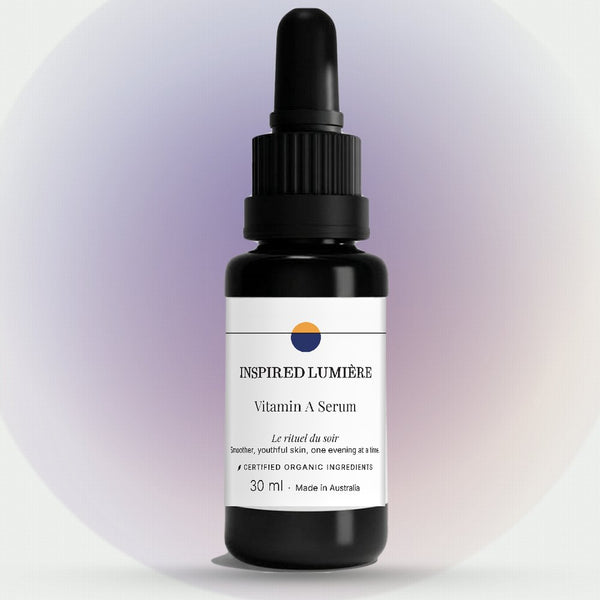
Ours is the Night Vitamin A Serum.
This article is general information, not personal advice. If you have a skin condition or take prescribed medication, talk to your GP or dermatologist.