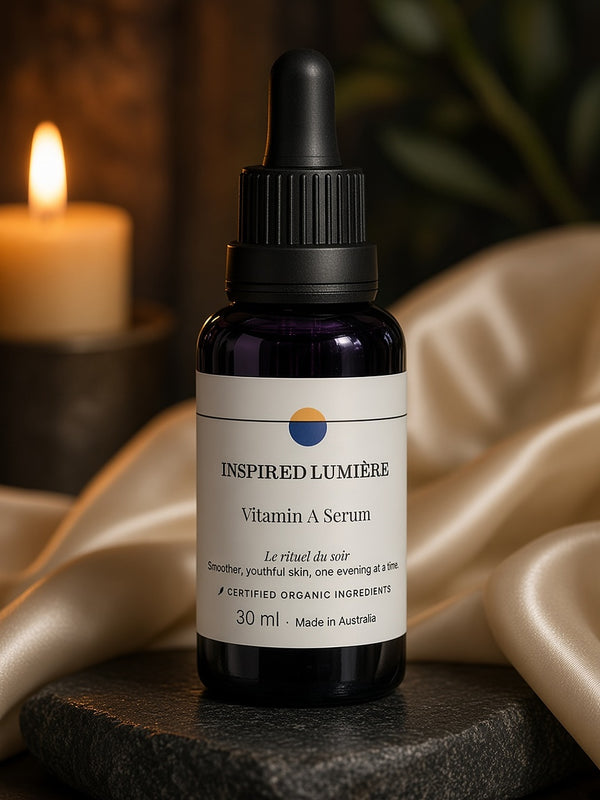
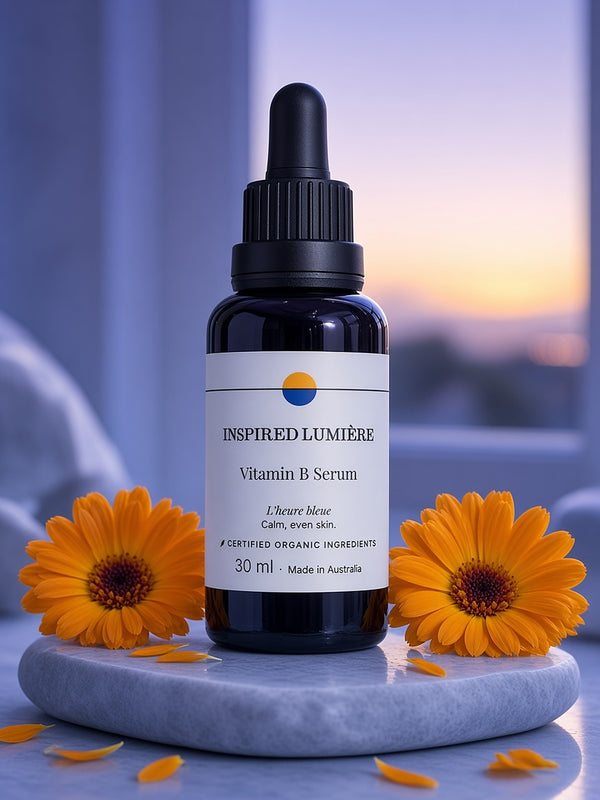
Ask which serum to start with and you'll get two answers, often from the same source. Retinol, because it has the most evidence. Niacinamide, because almost anyone can use it. Both answers are right, for different people.
Here's how to work out which one you are.
What retinol does, and what it asks of you
Retinol is a form of vitamin A, and it's the most evidence-backed ingredient you can buy without a prescription for the look of fine lines and rough texture. It works slowly, by encouraging the skin's own renewal, and published work on it generally looks at twelve weeks and beyond.
It also asks a fair bit of you. The first weeks often bring dryness, flaking or irritation while your skin adjusts, and the first eight weeks follow a fairly predictable pattern. It goes on at night only, because it degrades in light. And it leaves skin temporarily more sensitive to the sun, which in this country is not a footnote.
What niacinamide does, and what it asks of you
Niacinamide is a form of vitamin B3. Its job is supporting the skin barrier — the outer layer that holds water in and keeps irritants out — and every reasonable expectation follows from that: the look of smaller pores, a more even-looking tone over months, and skin that feels less oily by the end of the day.
It asks almost nothing. No adjustment period, no peeling week, no building up slowly, and it's fine morning or night. Its one persistent rumour, that it makes you flush, belongs to a different molecule with a similar name.
Start with niacinamide if…
- You've never used an active before. It's the gentlest introduction to the idea of a serum doing something.
- Your skin is easily upset. If vitamin C stings and scented products make you itch, start with the thing least likely to object.
- You can't afford downtime. A wedding next month, a work trip, a fortnight in the sun — niacinamide won't interrupt any of it.
- Shine and pores are what you notice. That's niacinamide's home ground, and in a humid summer it's the more comfortable of the two to wear.
Start with retinol if…
- Lines and texture are the main thing. Retinol has the evidence here. Niacinamide is the gentler road, not the same road.
- Your skin has already settled into a routine. A barrier in reasonable shape tends to make the adjustment easier.
- You can be patient. Two nights a week for a fortnight, then three, then build. Almost everyone who has a bad time with retinol went too hard in week one.
If you're pregnant
Retinol products are not recommended during pregnancy. If you're pregnant, trying or breastfeeding, talk to your doctor or midwife before using any retinol product — and check anything else in your routine with them too, niacinamide included. We'd rather you asked than assumed.
Using both
They aren't rivals. Niacinamide sits happily alongside retinol and is often what makes retinol easier to live with, because retinol tends to go better on skin whose barrier was in good shape to begin with.
If you want both, don't start both at once. The usual order is niacinamide first, because it asks nothing of you; give it a few weeks, then add retinol on two nights a week. On nights you use both, niacinamide goes on first, a minute to settle, then the retinol. If something objects, you'll know which one to blame.
What neither one does
Neither is a substitute for sunscreen, and in this country that's the part that decides the outcome. Neither does much in a fortnight. And neither does much used only on the nights you remember: both are slow, cumulative ingredients, and the one you use consistently will beat the stronger one you use now and then.
The short answer
If you're unsure, start with niacinamide. You'll still be using it in six months, and it's a good foundation if you decide you want retinol later. If lines and texture are what you care about and your skin is steady, start with retinol — slowly — and keep up the sunscreen every morning.
Related reading
- Niacinamide: what vitamin B3 actually does for skin
- Retinol purging or a reaction? How to tell the difference
- Retinol or vitamin C: do you actually need both?
Ours are the Lumière Vitamin A Serum and the Lumière Vitamin B Serum.
This article is general information, not personal advice. If you have a skin condition or take prescribed medication, talk to your GP or dermatologist.