"Vitamin C serum" describes a category, not an ingredient. There are at least half a dozen forms of vitamin C used in skincare, they behave very differently, and the front of the bottle rarely says which one you're buying. The ingredient list does.
L-ascorbic acid: the original
Usually listed as ascorbic acid, this is vitamin C itself, and by a distance the most-studied form in skincare. When you read about what vitamin C can do for the look of brightness and tone, most of that research was done on this molecule.
It's also the most demanding. It needs a low, acidic pH to work, which is part of why it's the form most likely to sting. And it's unstable: light, air and warmth break it down, and as it oxidises the serum goes yellow, then orange, then brown — the colour change that tells you most of the bottle has stopped doing much.
Good L-ascorbic acid serums exist. They come packaged to keep light and air out, and they're meant to be used up quickly.
The stable salts
Sodium ascorbyl phosphate and magnesium ascorbyl phosphate are vitamin C bound to a phosphate group, which makes them far steadier in the bottle. They work at a pH much closer to the skin's own, so they're gentler, and once in the skin they're converted to ascorbic acid.
The trade-off is the research. There's less of it than for L-ascorbic acid, and how efficiently that conversion happens is still argued about. What you get in return is a serum that behaves the same in week eight as it did in week one.
The other names you'll see
- Ascorbyl glucoside. Vitamin C attached to a glucose molecule. Stable and gentle, and converted to vitamin C in the skin.
- 3-O-ethyl ascorbic acid. Sometimes listed as ethyl ascorbic acid. A steadier relative of the original that turns up in newer formulas.
- Tetrahexyldecyl ascorbate. An oil-soluble form, often shortened to THD ascorbate. Stable, and at home in oils and creams rather than watery serums.
- Ascorbyl palmitate. An older oil-soluble form, often there to stop a formula's oils going off. On its own it isn't much of a vitamin C for skin.
Fruit extracts aren't a form
Kakadu plum, acerola, camu camu, citrus — a fruit extract on a label isn't a defined amount of a defined form of vitamin C. Whatever vitamin C the fruit started with is ordinary ascorbic acid, as fragile in a bottle as any other, and nothing on the label says how much survived. Kakadu plum is a remarkable fruit and a good supporting ingredient. It isn't a substitute for a named form doing the work.
What matters as much as the form
The form is one of four things, and all four count:
- The name. Look for it in the ingredient list, not in the claim on the front.
- The amount. Position is a clue: ingredients at 1% or more are listed from most to least. A vitamin C sitting near the end of the list is a token.
- The packaging. For L-ascorbic acid especially: dark or opaque glass, an airless pump, a small bottle. A see-through jar on a sunny shelf has a short life.
- How fast you'll use it. The most potent serum in the world does nothing at the back of a drawer, and a fragile one won't wait for you.
The honest trade-off
Here's how we put it on our own product page. L-ascorbic acid is the most-studied form and it works, but it's chemically fragile. Derivatives like ours, sodium ascorbyl phosphate, are gentler and steadier, and the research base behind L-ascorbic acid is larger.
If you want the most-studied molecule and you're happy to buy it fresh and use it fast, buy that. We'd rather you got the right thing. If you want a vitamin C that still works in week eight, that's what the stable forms are for.
Whichever you choose, it belongs under sunscreen in the morning, never instead of it.
Related reading
- Vitamin C serum: an honest guide for Australian skin
- Can you use niacinamide and vitamin C together?
- Vitamin C and sunscreen: which one goes on first?
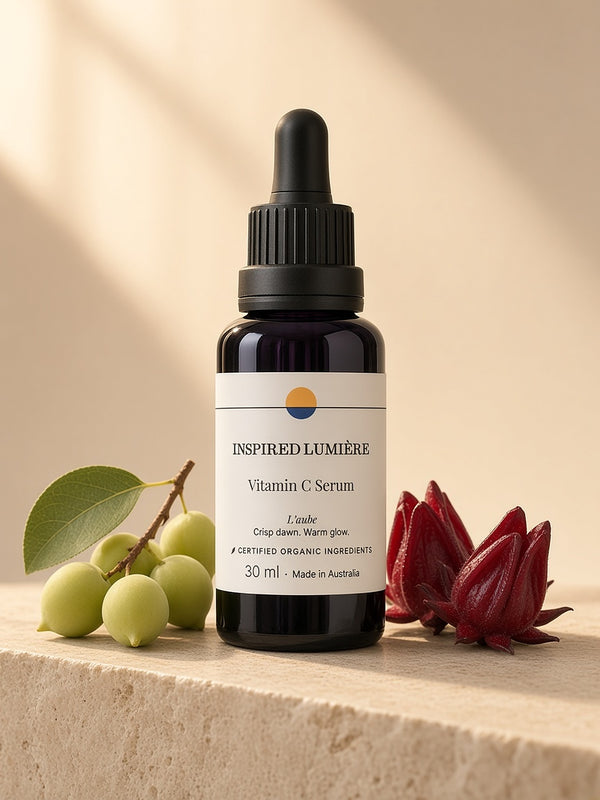
Ours is the Lumière Vitamin C Serum, built on sodium ascorbyl phosphate.
This article is general information, not personal advice. If you have a skin condition or take prescribed medication, talk to your GP or dermatologist.