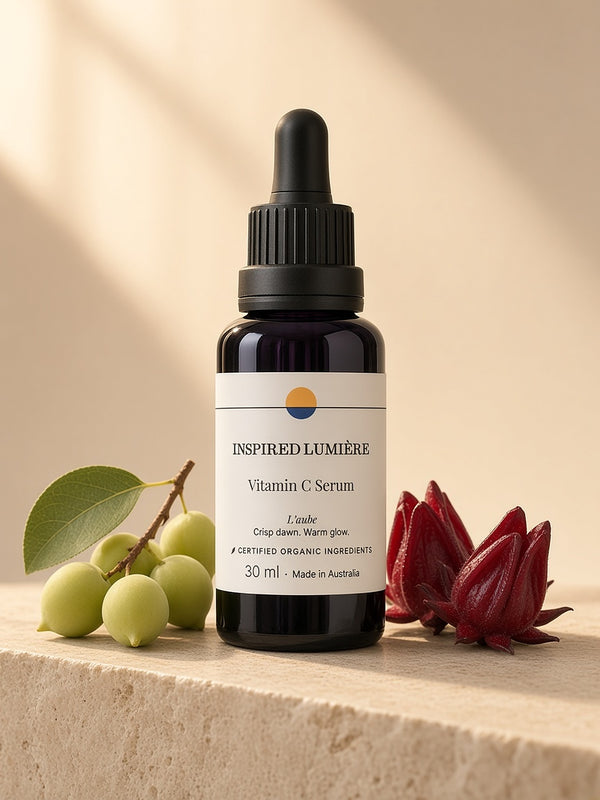
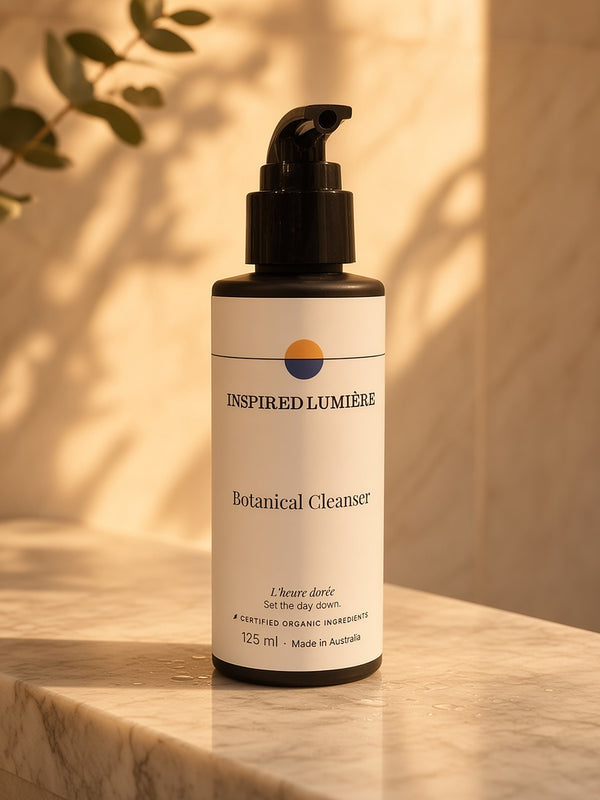
Kakadu plum is the ingredient Australian skincare reaches for when it wants to sound both native and scientific. It's on our labels too, in four of our six products. So it seems fair to say plainly what it is, what the numbers say, and what it can and can't do once it's in a bottle.
The fruit
Kakadu plum is Terminalia ferdinandiana, a small green fruit of the eucalypt savanna woodlands of northern Australia, from the Kimberley across the Top End. It has other names. Gubinge is the Bardi people's name, from the country north of Broome; billygoat plum and green plum are common ones.
Aboriginal people have eaten and used it for thousands of years. Most of the fruit sold today is still wild-harvested, much of it on Aboriginal-owned land. The cosmetics industry arrived very late to something a great many people already knew well.
The vitamin C numbers
Kakadu plum is famous for one thing, and the reputation is earned. The way it's usually quoted isn't.
Its vitamin C content varies enormously, from tree to tree and from one harvest site to the next. A 2024 study of wild-harvested fruit from the Kimberley measured anywhere from about 380 to almost 2,000 milligrams of vitamin C per 100 grams of fresh fruit. An orange has about 50.
So the fruit is extraordinary. But when a label says "50 times" or "100 times the vitamin C of an orange", it's quoting the very top of a wide range of measurements as though it were typical. And it's describing the fresh fruit, not what's in the bottle.
The fruit is also unusually rich in ellagic acid, a polyphenol antioxidant that berries like raspberries and strawberries carry in far smaller amounts. That gets much less attention than the vitamin C, though it's a large part of what makes the fruit interesting.
What happens in a bottle
This is the part the marketing skips. The vitamin C in a fruit is ordinary ascorbic acid, and ascorbic acid is fragile: light, air and water break it down, for the same reason vitamin C serums turn orange. Once a fruit has been harvested, processed, extracted and blended into a water-based formula, how much of its original vitamin C is left is hard to know, and nothing on the label will tell you.
That's why a serum meant to do vitamin C's job uses a defined, measured form of vitamin C (more on choosing one in our guide to vitamin C serums) and keeps the fruit as company rather than the engine.
In our Vitamin C Serum, Kakadu plum sits alongside sodium ascorbyl phosphate, a stable form of vitamin C. It's never the source of the vitamin C we're counting on. If a brand implies its vitamin C comes from Kakadu plum, ask which form and how much. The answer is usually instructive.
So what is it doing there?
An extract of a fruit this rich in antioxidants is a reasonable thing to put in skincare, as part of the supporting cast. In a cleanser you rinse off after a minute, it's a small inclusion, and our cleanser's page says as much. In a serum or a cream that stays on the skin, it adds antioxidant compounds alongside the ingredients doing the measurable work.
What it isn't is a reason on its own to buy anything. A product built around a native fruit and nothing else you can measure is selling a story, the way a lot of label vocabulary sells a feeling.
The questions worth asking, including of us
- Is it certified organic? Ours is an organic fruit extract. Certification tells you how the fruit was grown. It doesn't tell you where it was harvested, or by whom.
- Who benefits? Indigenous participation in the bush food industry has been reported at under 1%. A brand that can tell you where its native ingredients come from and who harvested them has done more homework than one with a prettier label.
They're fair questions to put to us, too.
The short version
Kakadu plum is a remarkable fruit with a long human history and a very high vitamin C content. In skincare it's a good supporting ingredient. The vitamin C you can count on in a serum is the defined form on the label, not the fruit beside it.
Related reading
- Vitamin C serum: an honest guide for Australian skin
- Why your vitamin C serum turned orange — and whether to bin it
- The last hour of the day: an evening skincare routine
It's in four of ours; the one built around vitamin C is the Lumière Vitamin C Serum, where it sits alongside a stable vitamin C.
This article is general information, not personal advice. If you have a skin condition or take prescribed medication, talk to your GP or dermatologist.